
November 5, 2026
Have you ever looked at a spoon and thought, ‘I could do better’?
I can’t say I have. But Rahul Agarwal did, after a senior student at design school told him there was no point redesigning something that had already reached its final form. Like the spoon.
Agarwal didn’t even cook but loved a challenge.
His story came to my mind after a conversation with fellow speakers about how we flag AI-created work.
What makes our own human contribution different?
I’d love to offer you a fully resolved answer. Instead, I have some ‘thinking in progress’ to share.
My first thought was curation. With so much AI slop to wade through, choosing what deserves your attention is a premium skill. I kept coming across the idea that ‘AI doesn’t have taste’.
I am a fan of David Hampian‘s nuanced thinking on this. He describes taste as having a point of view, making a judgment under ambiguous conditions and being willing to stake your reputation on the call.
In the National Gallery of Victoria, where I volunteer, I see human curators doing this every day. Making genius curation choices for the rest of us to enjoy.
Then there’s creation, which brings me back to Agarwal. He wondered whether measuring spoons could work differently. You know that beast: a set of different sizes held together on a ring, probably lurking in one of your kitchen drawers.
Within three days, he had a prototype. Getting it to work took almost three years. He replaced six measuring spoons with two origami-inspired spoons that fold flat and landed him a deal on Shark Tank USA.
And then there’s being a bit crazy, which is where I do some of my best work. Oh, that and modesty.
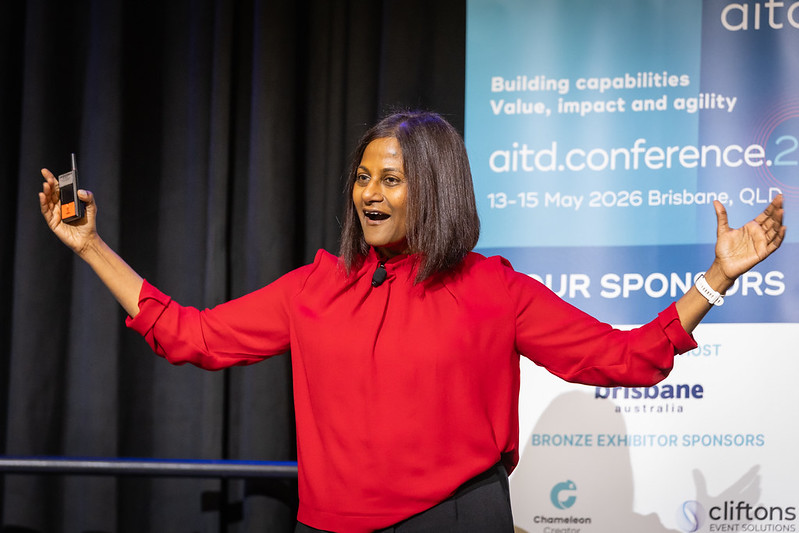
Last week, I was presenting to a leadership team in Melbourne. The MC introduced me, I stepped up, and there was complete silence.
I looked straight at the audience and said, ‘Oh, the polite convention here is applause.’
They laughed and started clapping. I tossed my hair and did the whole Miss Universe thing. ‘Ah, stop it, please,’ I said, wiping a fake tear from my eye.
The audience was in fits of laughter.
So three things: curation, creation and crazy, that might distinguish our contribution from AI’s.
A neat answer. And I do love a list of three, like who doesn’t?
Except AI can curate content, data and information and help select and assess creative ideas. What it can’t do is stake its reputation on the pick.
It can create, combine and recombine existing information to produce what looks like new ideas and come up with crazy too, depending on how you prompt it and your domain expertise (and I don’t mean AI hallucinations).
Perhaps I started with the wrong question.
In that room in Melbourne, I felt most human in the shared laughter.
What makes you feel most human at work?

Discover my One Powerful Tip to Unleash Your Storytelling
Discover the single most transformative technique that will take your narratives from ordinary to extraordinary. Whether you’re a writer, filmmaker, or simply someone who loves to share stories, this tip will revolutionize the way you craft and present your tales.
Recent Posts
Nov. 05, 2026
I’d love to offer you a fully resolved answer

Oct. 29, 2026
When you live what you teach, magic happens

Oct. 23, 2026
Happy Global Champagne Day, you special person
Oct. 15, 2026
From hell in a handbasket to heaven with a clipboard
Oct. 08, 2026
How do you find new and interesting things?
Oct. 01, 2026